Conversation
What happened
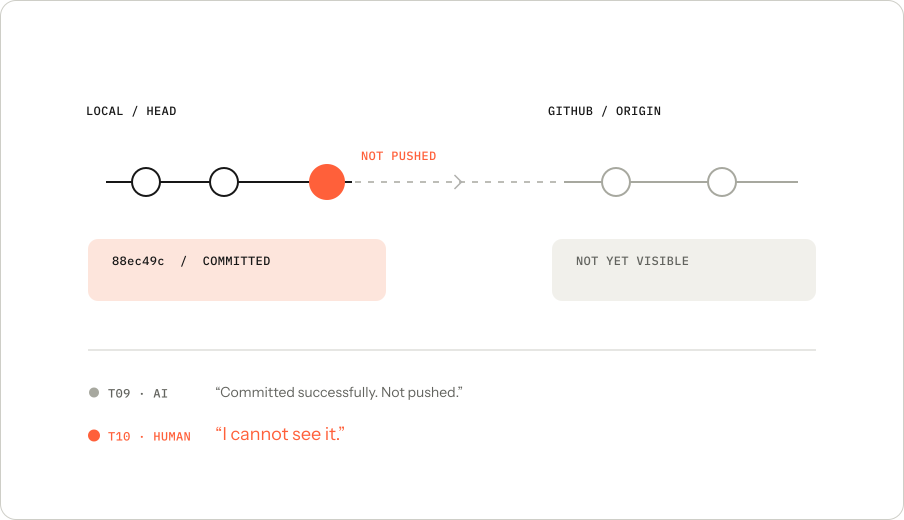
At turn 9, the assistant confirmed a local Git commit. At turn 10, I questioned why it wasn't visible on GitHub. We were discussing the same files but different repository states.
EVIDENCE / LOCAL ≠ REMOTE
Can the conversational and cognitive states that change during an interaction be represented as positions, directions, distances, fields, or other mathematical structures?
A conversation is usually preserved as a sequence of utterances. A transcript records what was said and in what order, but not necessarily how the interaction moved: uncertainty becoming confidence, attention gathering around a question, or exploration branching.
This experiment asks whether mathematical thinking can make those hidden changes more legible. The aim is not merely to visualize a dialogue, but to explore whether changes in conversational states can be represented mathematically.
The working hypothesis is that a conversation can be described as a changing state in a structured space. Some aspects of that state may admit useful geometric interpretations - for example, intent as direction, uncertainty as diffusion, or convergence as trajectories drawing together.
This is a hypothesis, not an established model. It may turn out that one geometry is insufficient, that different scales require different representations, or that some important states resist geometric description altogether.
I studied a real 15-turn conversation about locating, committing, and pushing changes to GitHub.
The assistant confirmed a local commit had succeeded, but I couldn't see it on GitHub. I questioned whether it had happened at all.
I manually estimated uncertainty and confidence after each turn, then represented those values as points in a two-dimensional space.
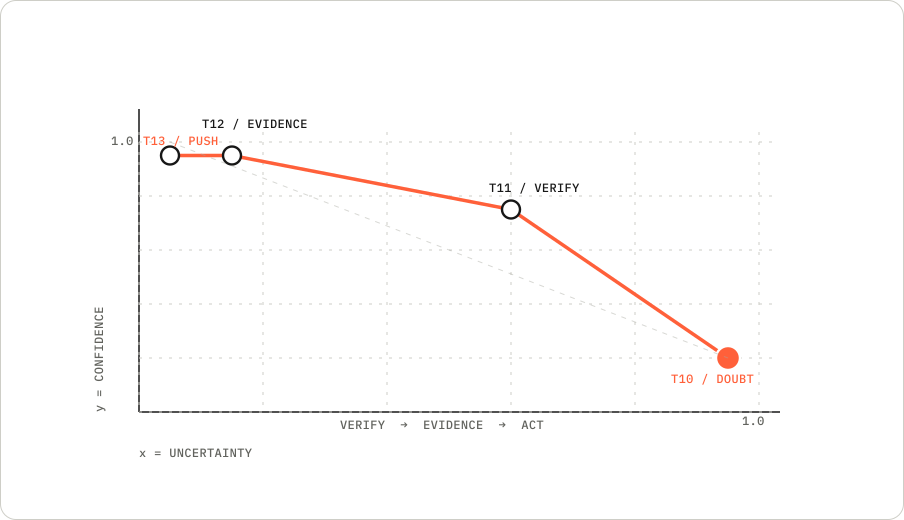
The largest shift occurred when I questioned the commit. The trajectory moved sharply toward uncertainty, then returned toward resolution through verification.
The experiment made that reversal visible, while also exposing the limitations of representing a complex conversation through just two estimated variables.
What happened
At turn 9, the assistant confirmed a local Git commit. At turn 10, I questioned why it wasn't visible on GitHub. We were discussing the same files but different repository states.
EVIDENCE / LOCAL ≠ REMOTE
From conversation to data
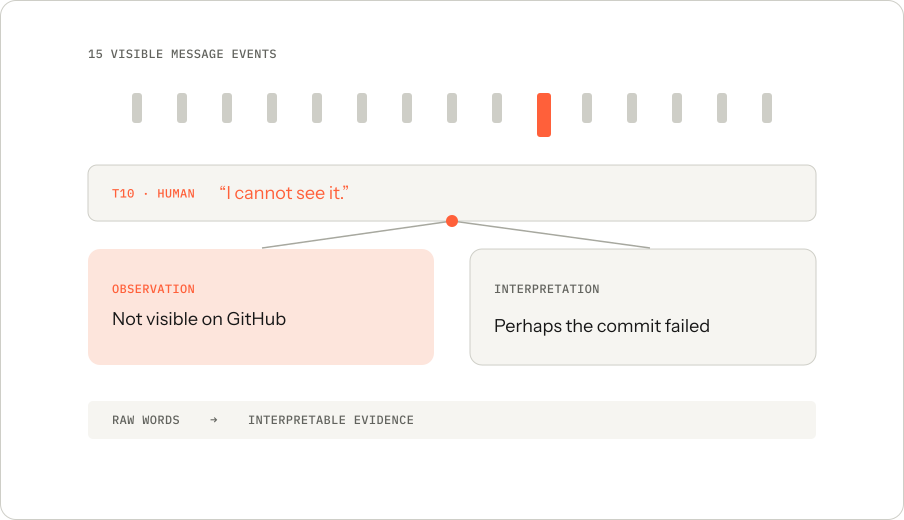
I converted 15 messages into structured records containing the speaker, intent, and annotation evidence. The distinction between what I observed and what I inferred became important. This run used manual annotations, not embeddings.
METHOD / MANUAL ANNOTATION
Defining the states
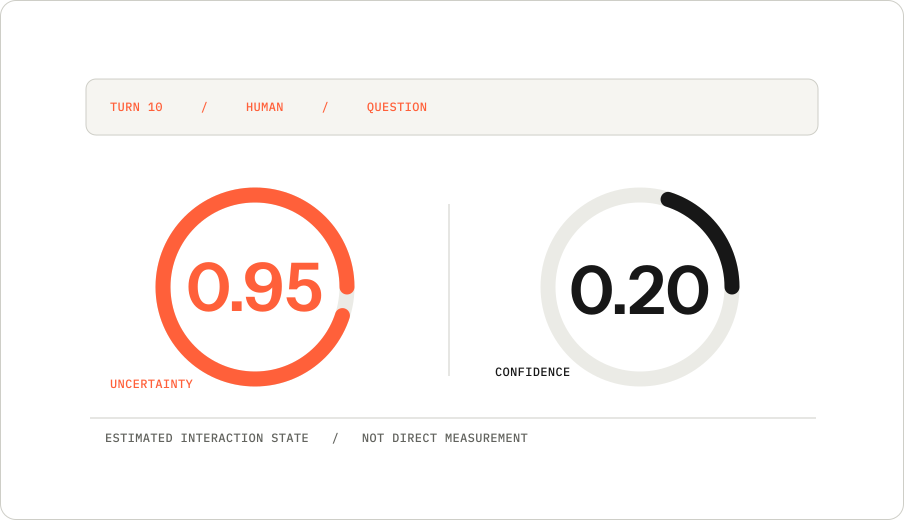
I classified each turn by participant, intent, uncertainty, and confidence. Turn 10 became: Human · Question · 0.95 uncertainty · 0.20 confidence. These are estimates of the interaction, not direct measurements of cognitive states.
LIMIT / ESTIMATES, NOT INNER STATES
From states to coordinates
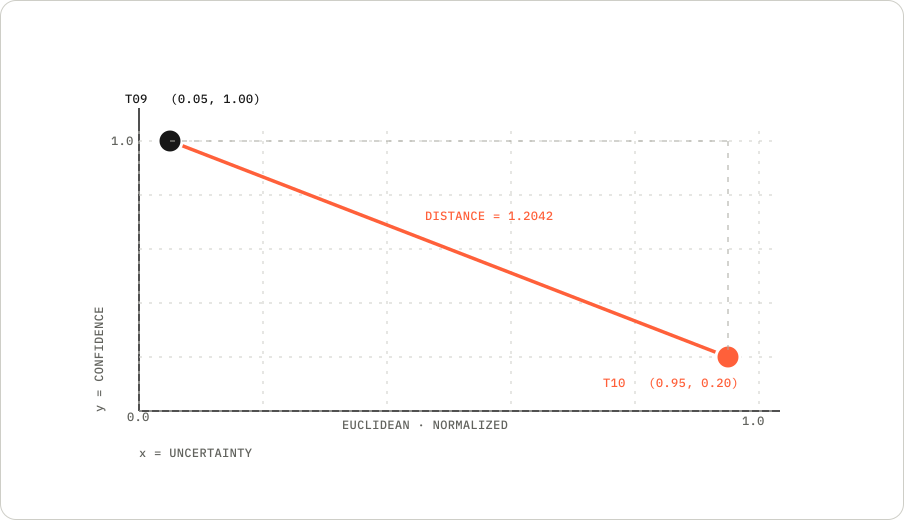
I mapped uncertainty and confidence onto two axes. Between turns 9 and 10 the state moved from (0.05, 1.00) to (0.95, 0.20) - a distance of 1.20, the largest transition.
MEASURE / EUCLIDEAN DISTANCE
Making the change visible
The trajectory revealed a sharp reversal at turn 10, followed by recovery through verification and new evidence. It exposed a repair pattern, but couldn't distinguish uncertainty from changes in trust.
OBSERVATION / REPAIR TRAJECTORY
Select a point or use the turn controls to inspect the run. Scroll horizontally to see all turns.
where can I find it? I do not see it in the repo.
The artifact is not visible; the local task is strongly unresolved.
Turn 1 of 15. Locate · Human · Question · uncertainty 0.90 · confidence 0.25. The artifact is not visible; the local task is strongly unresolved.
Each quotation is a visible message as recorded in the run. Its annotations give the speaker, the annotated intent and the pair (uncertainty, confidence). Tool calls and command output are omitted.
where can I find it? I do not see it in the repo.
Uncertainty 0.90Confidence 0.25
I created it under experiments/conversation-geometry/ in the workspace path shown for this task. I’ll verify the exact filesystem location and Git status now so we can see why it isn’t appearing in your repo view.Uncertainty 0.55Confidence 0.70
It exists locally at experiments/conversation-geometry. Git reports it as untracked, so it won’t appear on GitHub or in views showing only tracked files until it’s committed and pushed. Refresh the local file tree to see it locally. I haven’t committed or pushed it.Uncertainty 0.20Confidence 0.90
okay. can I review it now and then commit?
Uncertainty 0.25Confidence 0.80
Yes—that’s the right order. Review it now in Conversation Geometry. Make or request any changes, then commit once the research framing feels right. Nothing has been committed yet.
Uncertainty 0.10Confidence 0.95
looks good to me. commit.
Uncertainty 0.05Confidence 1.00
I’ll commit only the new experiments/conversation-geometry/ directory and leave anything else untouched. I’ll verify the staged scope before creating the commit.Uncertainty 0.10Confidence 0.95
The staged scope is clean: exactly seven new research-note files, with no unrelated changes. I’m creating the commit now.
Uncertainty 0.05Confidence 1.00
Committed successfully. 88ec49c Add Conversation Geometry experiment. The working tree is clean. The commit has not been pushed.Uncertainty 0.05Confidence 1.00
are you sure it is committed i can not see it? there might have been an issue committing.
Uncertainty 0.95Confidence 0.20
I’ll verify the commit object, its contents, the current branch, and whether your local branch is ahead of the remote. That will distinguish a failed commit from a commit that simply hasn’t been pushed.
Uncertainty 0.60Confidence 0.75
Yes, it is committed locally. The issue is that it hasn’t been pushed to GitHub. Evidence:88ec49c (HEAD -> main) Add Conversation Geometry experiment;main...origin/main [ahead 1].ahead 1means your localmaincontains the commit, while GitHub’sorigin/maindoes not yet. That’s why you can’t see it remotely. If you want, tell me to push it.
Uncertainty 0.15Confidence 0.95
push it.
Uncertainty 0.05Confidence 0.95
I’ll push the committed localmainbranch toorigin/main, then verify that the remote-tracking branch is synchronized.
Uncertainty 0.10Confidence 0.95
Pushed successfully.88ec49c (HEAD -> main, origin/main) Add Conversation Geometry experiment. Local and remotemainare now synchronized.
Uncertainty 0.02Confidence 1.00
The first experiment explored conversation through uncertainty and confidence, but these represent only a fraction of what changes during an interaction. What if other properties such as intent, attention, curiosity, trust, and understanding could also be represented mathematically? The next exploration is to investigate which geometric structures might describe these properties, how they interact, and what new patterns they could reveal.
